[ page 16]


McDonnell Douglas (Boeing) F-15 Eagle Plastic scale models in 1/72 scale
... continued from page 15.....
modelling reports
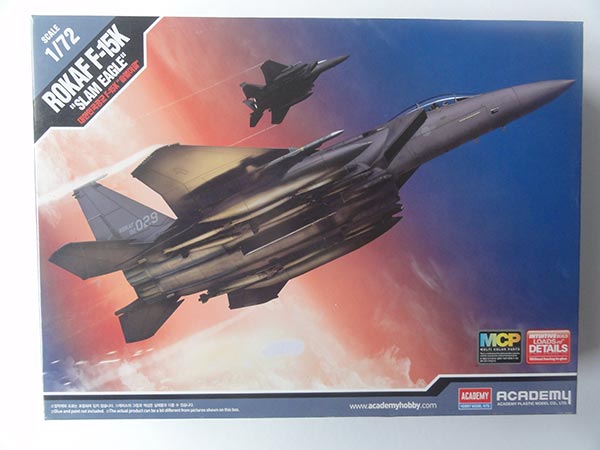
 F-15K
Academy kit #12554 also released in 2017 a kit for the F-15K "Slam Eagle". This kit has the same parts as the Academy F-15E discussed earlier on page 8.
The Republic of South Korean Air Force (ROKAF) has a large F-15K fleet that uses both the GE F-110-GE-129 and the P&W F-100-PW-229 engines. It is unknown why they have both engine types in their fleet as this increases maintenance costs. But both options are in the kit.

In this kit some sprues have different colours to help the modeller "that does not want to paint" the grey Korean F-15K. Some parts are "clicked together" but sometimes it is better to remove pins and glue obviously. But the parts look fine.


The fast packs are integrally moulded with the main fuselage and various pylons and stub pylons are provided. It is unknown to me what type of stub pylons are used in the F-15K. Some references suggest these are a different type: BRU-47A releases racks in extended stub pylons. It seems that the kit has the extended stub pylons used thus both at South Korean F-15K (and F-15SG Singapore).

Stores and weaponry appear to be:
- AN/AAQ-33 sniper pod
- AN/AAQ-13 pod
- AIM-120 AMRAAM
- AIM-9L Sidewinders
- mk 82 dumb bombs
- 600 gallon fuel tanks

Decals are only for Republic of Korea Air Force (ROKAF) F-15K with codes 001, 029, 047, 061 but these schemes are all FS36118 and rather dull.

Some F-15K jets use the GE F110 engine with a different internal intake fan and external different exhaust and are nicely provided in these kits. Some others have still the P&W F100, also provided in the kit.
Academy kit assembly was now done very similar as the previous Academy F-15E models made BUT now with the GE F110 engine exhausts for one of the ROKAF F-15K Slam Eagle as provided with the kit decals. I picked scheme for the F-15K "029".
The deep inner fuselage air ducts are nicely provided as white coloured plastic and set with the correct engine fan. The upper air brake was set closed, snug off a bit the hinge pins for a better fit.
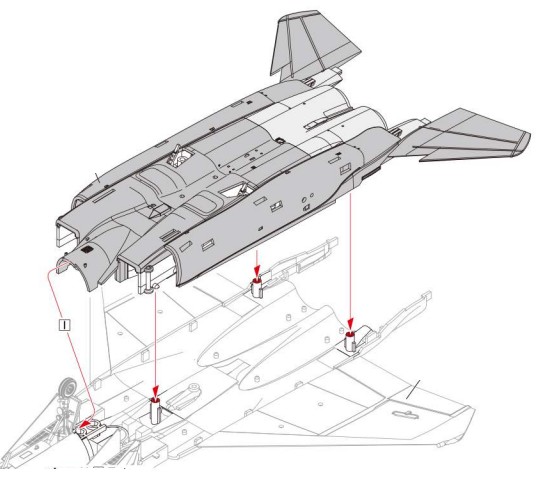
When joining the bulbous Strike Eagle fuselage #N1 with integrally moulded fast packs with the wing-fuselage part the horizontal stabilizers are set. It is better to reduce the locator pins a bit in length. Than just a bit pressure is needed as these will fit and use thin fluid cement. Sharp engineering!

Snug fit in place after metal colours had been applied.

The rear edges were sanded flat to get a better installment of the pair of GE exhausts later on.
Just paint the cockpit tub, I will add the details later on.
Do not fit the landing gears and not the nose gear strut #G3 at this stage to avoid breaking it.
Some radar nose edge sanding was needed for a smooth fit. The forward nose gear door is to be set closed as seen on most parked Strike Eagles.
The wing and inside panels and intakes will fit OK without any issue. The forward fuselage joints needed a bit putty and sanding but I think it was my fault to get a perfect joint.

The intake side bulges #B5 and#B6 will also snug in place. I needed a bit putty and sanding here. I was not sure if the gun barrel nozzle is missing.. can be added later on.
Do not yet install the vertical tails and jet exhausts, leave for later.
The various F-15K pylons on the fast packs were installed. (see note above...). I removed the pins to fix the small bombs though and fitted the pylons.

After this general assembly, base paint work would start. A base grey primer was airbrushed with thinned Revell Aqua 75 steingrau acrylic paint to check for any flaws. It looked OK.
The wing fuel tanks and pylons were not forgotten and needed a bit smooth sanding. Reduce the pylon pins a bit in length to set on the lower wing. Same with the various LANTIRN pods provided with a choice of these provided in the kit.
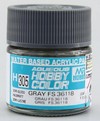
The Strike Eagle gunship gray Federal Standard FS36118 overall coat paint scheme was airbrushed with thinned Gunze Sangyo H305 acrylic paint. Use the Gunze Sangyo Mr.Hobby thinner. Also airbrush a spare clear decals paper just in case any later gaps need filling and repairs.
The smaller parts while still in their sprues like gear door outsides', wing pylons and launch rails were not forgotten as were the wing fuel tanks. The gear door insides' were airbrushed white as were the landing gear legs and struts still in their sprues.
The model had been airbrushed glossy FS36118 and got another few coats of gloss varnish (as to avoid "silvering"). I airbrushed my usual Johnson Future / Pledge varnish thinned with 10% Gunze Sangyo Levelling Thinner.
The surrounding areas of the metal areas were masked with tape and airbrushed aluminium with Vallejo 77.701 acrylic. This is easy as the vertical tails were not yet installed.
Decalling was done now for the kit F-15K scheme of "029". Applying the decals took some 2 1/2 hours.


Back to the cockpit: the ACES ejection seat parts in the kit are basic but adequate for this scale and were painted tyre black, seat cushions/ para packs olive drab green with some seat straps made from tape. I removed the lower seat location tabs for easier installment.
The vertical tails, landing gears, doors and pods were now installed as per kit. The nose gear strut has the shimmy damper as fitted on Strike Eagles like F-15E, this South Korean F-15K and Singapore F-15SG.
On the kit F-15K vertical tails, I could not check if these have weight rods on top or ECM warning antennes (like on the F-15SG). Probably ECM warning antennas, I used the kit parts.
If you have when fitting a vertical tail a small tail base gap, apply some white glue to fill, swipe off and paint when dried.
The main landing gear and wheel bays colour is white and these were brush painted. I added some wash as well. Note that the main gear struts are posed at a slight angle (about 85 degrees) and that the main wheels are thick just like on the F-15E Strike Eagle.
The many pylons and stub pylons on the Conformal Fuel Tanks / fast packs were installed.

The AN/AAQ-33 sniper pod and AN/AAQ-13 pod were set below the intakes.
I opted to install some other special weaponry on this F-15K that the South Korea AF can deploy: Harpoon anti-ship missile and a Taurus stand-off cruise missile. The Taurus missile is really state of the art.
The Harpoon missile was found in the spares box (may be from Hasegawa S-3 Viking kit) and the Taurus came from the Revell Eurofighter Typhoon kit.
These missiles have different wing pylons than supplied in the Academy kit so from thick plastic card new pylons were made looking at photos. I enscribed a few panel lines on the wing pylons.
These pylons were hand painted FS36118 and weaponry was installed. I also added a few metal paint dots at the fast pack pylons BRU rack braces.

The canopy would be set closed on this model. The prepared ACES seats were installed and the canopy set. There are a few tiny gaps and these were filled with White Glue and when dried painted FS36118.
Than smaller bits followed like the pitot tubes. The anti-collision lights were painted and the refuel panel a mix of metal and green but colour varies.
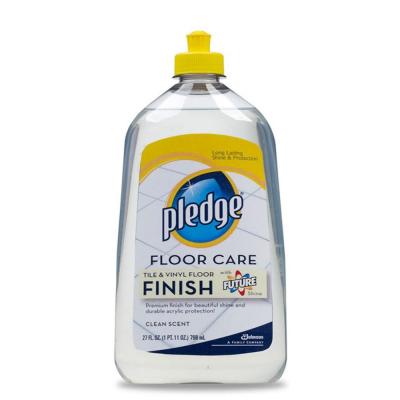

Last step: the overall model got a semi-gloss varnish airbrushed with Johnson Pledge acrylic varnish thinned with 5% Gunze Sangyo Mr.Color levelling thinner and 5% Tamiya X-21 mattting flat base. Shield off the transparant areas. This is to get an even sheen and protect the decals. That completed a nice South Korea F-15K 1/72 model.
The different GE engine exhausts are well seen here....


[ area: 100,363 sq.km | population: 51,7 million | capital: Seoul | GDP USD 35,000 per capita nominal ]
The
South Korea Air Force was set-up with American aid from 1948, flying
with Pipers. There was the big Korea War. The Republic of Korea Air Force (ROKAF) got additional
light aircraft and later F-51's, the USA had military bases in the
country. In the 1950s jets were delivered with some 140 F-86 Sabres,
T-33 and F-86D. In the 1970s F-4 Phantoms were acquired and F-5's.
Helicopters were flown as well as transports like the C-46 and C-123.
In the mid seventies delivered were some 40 T-37 second hand jets from
Brasil and some 28 ex-VNAF A-37's. Under the "Peace Bridge" program
some 40 F-16C/D were delivered but also over 50 additional F-4D/ F-4E/
RF-4C. For training the T-38 was leased. Local
industry such as Korea Aerospace Industries (KAI) did license production
with the "K.." designation such as KF-5E/F and later KF-16
of which over 120 F-16C/D put into service. And the F-15 "K"...
The F-15K is an improved version as compared to the F-15E with a multirole capability and quite advanced. The radar is the AN/APG-63V1 AESA and is capable to track
surface targets. The cockpit has many displays and the Helmet Mounted
Cueing System is used. In
2002, first 40 F-15K were ordered and first jets were manufactured in
St.Louis USA with first roll out on March 16, 2005. In 2005 Boeing
agreed that substantial sections were to be under license manufactured
by Korea Aerospace Industries (KAI) in Sachon, South Korea. Now over 60
F-15K have been delivered to the ROKAF. Weapons include
AIM-9X, AIM-120C, AAQ-14 pod and
more recently also upgraded to fire AGM-84K Harpoon Block 2 anti-schip
missiles, TAURUS stand-off missile and AGM-84K SLAM-ER can be deployed. The F-15K is one of the most advanced strike jets currently in service.


F-15K, 02-029, c/n 1404/K29 delivered from 2008 to the South Korea Air Force (ROKAF). It flies with the no.11 Fighter Wing.


... set in scenery at Osan Air Base, South Korea ....

Academy of South Korea released also an 1/72 F-15C Eagle kit #12582 in 2023 with decals for several USAF Oregon Air National Guard fighter squadrons. On the box top is shown a 75th year Heritage scheme with "D-day" stripes.
The Academy F-15C kit moulds are quite old, probably from 1991. So the parts have nothing in common with the Academy F-15K kit seen above but this old kit can be made quite nice as you will see below.
 F-15C
About the provided scheme: the USAF had the Multi Stage Improvement Program for many F-15C flying though there are variations. Some smaller provided parts are probably for an F-15C jet that had the MSIP upgrade like parts #A44. The decals sheet also suggests this as the rear low visibility lights decals have a small split in between them.

The decals sheet has markings for 3 USAF ANG schemes:
[1] F-15C, USAF, 123 FS/ 142 FW of the Oregon ANG as flown in 2021;
[2] F-15C, USAF, 114 FS/ 172 FW of the Oregon ANG as flown in 2015;
[3] F-15C, USAF, 114 FS/ 173 FW of the Oregon ANG heritage scheme as flown in 2020 with "D-day" stripes.
The kit decals look excellent with lots of stencilling and well researched.
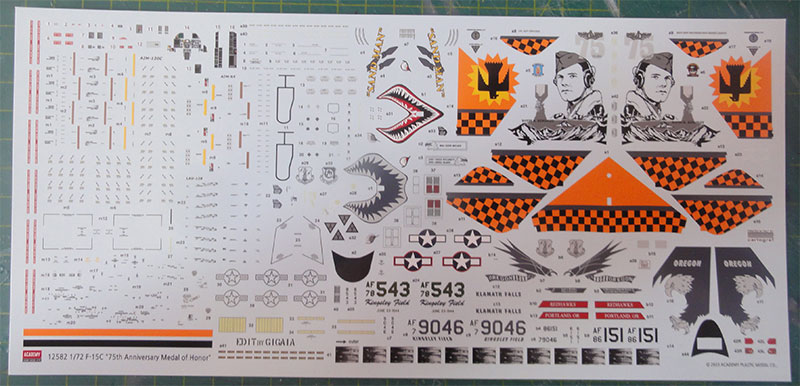
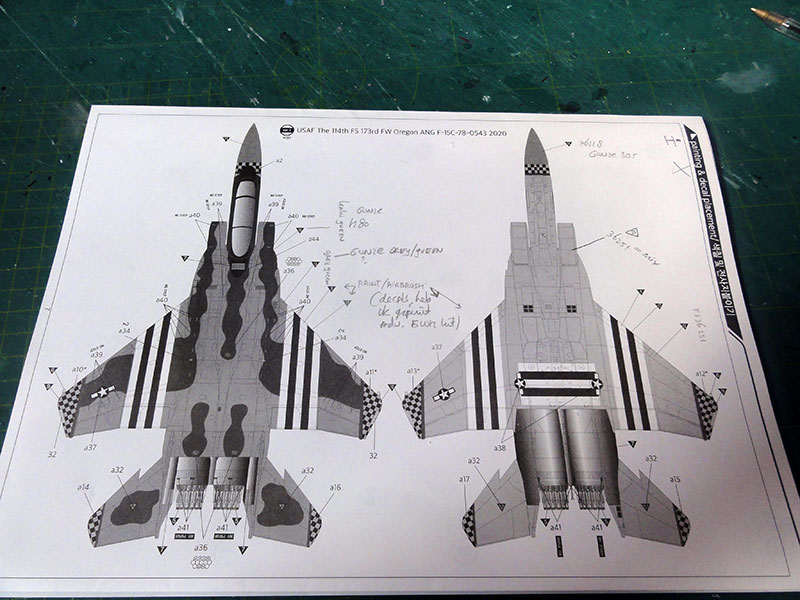
The last attractive scheme [3] was picked for this to be made model. Note that the D-day alike stripes ARE NOT decals but need to be masked and painted by the modeller.
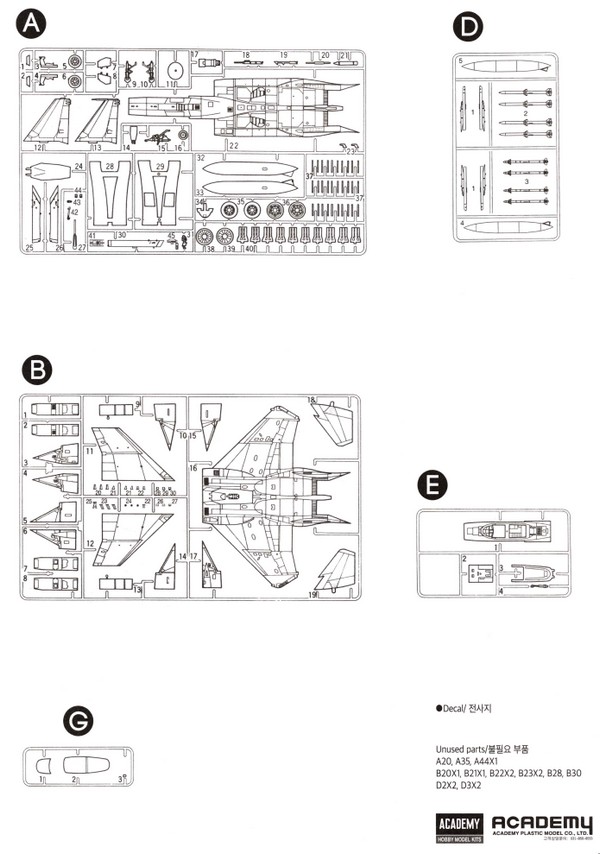
There are 3 sprues with plastic parts with an extra sprue for the armament and a transparant canopy and windscreen, totalling about 75 parts. The nose section is horizontally split.

The instructions are simple but clear and includes a large modelling paints table with different brands.
You see here I already airbrushed some parts.....

Some gear doors are moulded closed as seen usually on parked F-15 Eagles.


The canopy and windscreen are separate parts as is the radar cone.
The extra sprue is provided in this kit release with armament parts for AIM-9X and AIM-120C missiles as well as a extra external fuel tank.
The kit parts panel lines are recessed.
Inside the fuselage there are long intake air flow ducts, very nice for such an old kit. The appropriate Pratt and Whitney F100 engines without "turkey feathers" are in the kit but also unused parts for presumably the GE F110 engines. You also get an external ladder part #A19.
This 1/72 Academy F-15C kit was made rather straight out of the box.
The canopy would be set closed on this model. In the basic cockpit tub I added a rear bulkhead made from plastic card. I opted to set the canopy closed on this model so not a lot of extra details were added in the cockpit. You get decals for the instruments. I painted the cockpit tub and sides medium grey FS36321. Though the ACES ejection seat is simple, not bad when painted tyre black, seat cushions olive drab green and added just some seat straps from tape.
This particular F-15C had the rear tail hook fairing removed to save weight, just a tail hook. This is correctly indicated in the kit instructions to remove it.
I opted to set both ailerons a bit drooped as often seen on parked Eagles. Make cuts a with a razor saw and bend.

The fit of the rear upper fuselage to the upper nose section is quite bad. I needed sanding, putty and sanding. Also at the air brake that was set closed. The forward fuselage sides also needed sanding and putty.

At the lower areas, sanding and putty was needed at the intakes.


The lower rear fuselage air scoops were not yet installed as the D-day paint scheme stripes run there. The rear fuselage areas were airbrushed aluminium metal with Vallejo 77.701 acrylic and masked.

The vertical tails and stabilizer, landing gear and pylons were not yet installed. First the paint scheme would be applied. First the model got a base grey coat airbrushed with thinned Revell Aqua 75 steingrau to check for any flaws and an even base for the paint scheme.

The kit paint scheme [3] has quite peculiar Heritage colours:
[a] lower surfaces FS36251 for which I used a paint mix of Gunze Sangyo Mr.Hobby acrylics of 70% H308 + 30% H317; (note: some sources suggest the colour is FS36375 but on photos it appeared grayer);
[b] upper areas camouflage of gray-green for which a paint mix of 90% Revell Aqua 75 steingrau + 10% green was used (sorry... I forgot what green);
[c] upper areas camouflage pattern of khaki green with Gunze Sangyo H80 (or H64);
The radar nose is probably FS36081 gray (not FS36118).
The white-black D-day stripes need to be painted. But I was lucky to have spare decals set from other Academy F-15E kits and these look to have a similar layout. Otherwise, mask and airbrushed the white and black stripes.
Airbrush first the lower surfaces with paint mix [a]. Do not forget the stabilizers lower surfaces, pylons and tanks. Than mask and airbrush the upper camouflage colour mixes and also the vertical tails and upper stabilizers.

Before decalling was done, the model got a gloss clear varnish coat airbrushed to avoid "silvering". I airbrushed thinned Johnson Future/ Pledge.
Decalling was done next with the excellent kit decals. Take your time here, at least 3 hours.
The spare decals set from other Academy F-15E kits came in handy for the D-day stripes.....


After decalling was done, the remainder smaller parts were installed.
The gear bays were hand painted white on their insides just like the gear doors. The landing gears were installed. The nose gear strut does not have the shimmy damper and the usual main gear wheels and doors which is correct for the F-15C. The gear struts are white and I painted the oleos and landing lights Vallejo Chrome 77.7097. Tyres in "tyre black". Some extra hydraulics brake lines were added on the gear legs from thin back stretched sprue.
Kit exhausts for Pratt & Whitney F100 engines without "turkey feathers" were installed after they had been assembled and airbrushed metal.
The smaller MSIP parts #A44 were installed and painted as well.
The vertical tails were set and the stabilizers.

At the wing tips and tails anti-collision lights were painted (red port and blue starboard) and a few on the vertical tails.

With a soft pencil, some panels were outlined and the flap and rudder recesses made darker with a thin black wash.

The model got a center fuel tank and a few missiles as pere kit (or get from a Hasegawa weapons set).

The canopy and windscreen frames were hand painted gloss black. At the rear of the canopy is a grey frame section. The ACES ejection seat after it had gotten painted and some straps was set with pilot control stick and HUD.
The separate windscreen fitted OK. But the canopy was set closed and there remain a few gaps. These were closed up with white glue and painted black when dried.
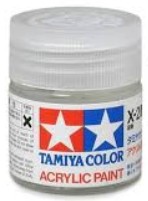

Finally an overall semi-matt varnish coat was airbrushed of Johnson Future/ Pledge with 5% X-21 "flat base" and 10% Gunze Sangyo Levelling Thinner with the usual technique. Shield off the canopy and windscreen.
That completed this model.
 USAF

F-15C, USAF, coded "78-0543", 114 Fighter Squadron / 173 Fighter Wing of the Oregon ANG flown in 2020 with "D-day" stripes for rememberance.
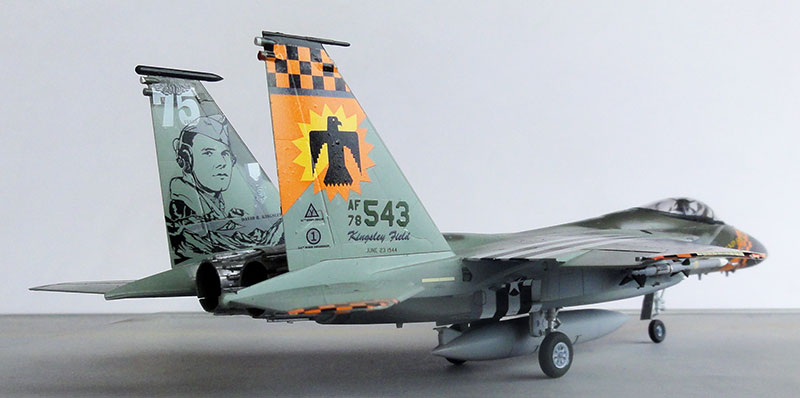


... set in a scenery...

That completed a pair of Academy F-15 kits.
MORE F-15 MODELS TO FOLLOW!

(c) Copyright "designer"/ All rights reserved. Your comments are welcomed by webmaster
Created this page Oct 25, 2026