[ Page 5 ]


F/A-18 Hornet in 1/72 scale: new generation Super Hornet F/A-18E and F/A-18F
... continued from page 4...

This part of the Hornet modelling report covers the next generation Super Hornet F/A-18, manufactured from 1997 by Boeing. The Super Hornet family got quite some new features as compared to the Hornet and extra Strike capabilities.
The F/A-18E is the single seat version and the F/A-18F the two seater. The type got a longer fuselage, bigger wing with a saw tooth, different strakes besides the forward fuselage, bigger intakes for the new engines and different systems.
The first flight of the F/A-18E was in November 1995. Over 630 Super Hornets have been manufactured.
Later, the F/A-18G Growler two seater was developed as replacement of the EA-6 Intruder. Flown by the US Navy from the year 2000 these jets operate from CVN nuclear carriers. The Super Hornet was also ordered by Malaysia an Kuwait for their air forces.
In 1/72 scale several F/A-18 first generation kits appeared and some were discussed on the previous pages....

Hasegawa released their first 1/72 F/A-18E kit #00549 in 2004. But I purchased release #00999 in 2010 of the special edition with decals for the US Navy VFA-14 Tophatters. Just this scheme is provided with decals and the needed stencils. A good feature is that Hasegawa gives the choice of using full decals with black patterns or to airbrush the black patterns yourself and than add the extra markings.
The model will be made in this scheme with a mix of airbrushing and decals.
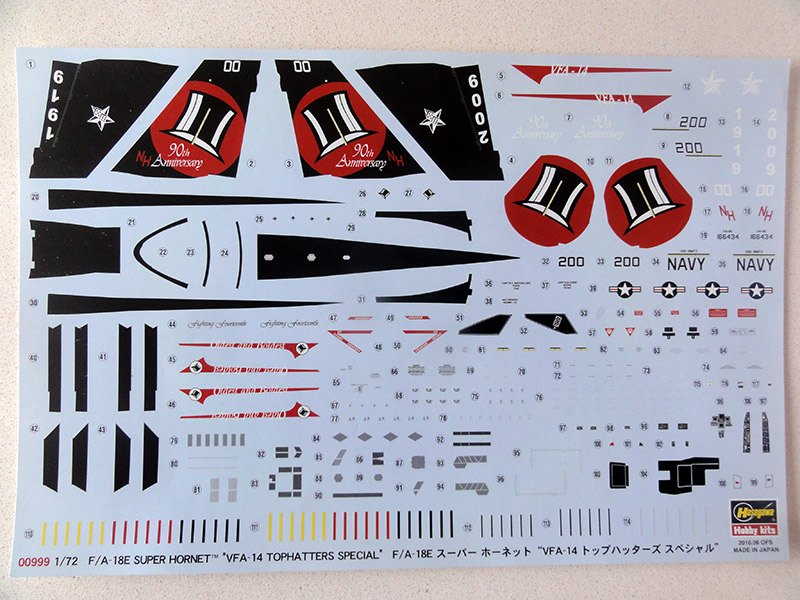

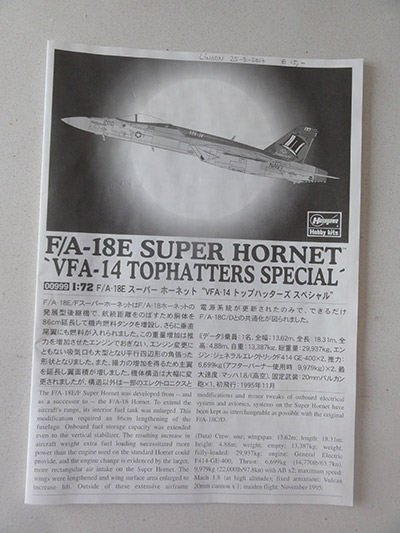
The black and white printed kit instructions are fine with 13 STEPs for assembly.

It is a nice Hasegawa kit with fine parts and nicely done recessed panel lines with about 50 parts for the jet.


Black stabilizer soft plastic rings are provided as well to "move rotate" but I will set them fixed.

The engine nozzles are moulded "with afterburner closed" only. Note the 2 seats in the kit as parts are similar in the two seater kit.
Thankfully Hasegawa supplies now some stores/ weaponry. In the past you had to buy their separate weapons sets:
You also get an additional 40 parts with pylons like external fuel tanks, AIM-120 and AIM-9 missiles and a AN/ASQ-228 ATFLIR pod. (*Super Hornets often deployed laser guided bombs, these are not provided). The wing pylons are the later style with straight trailing edge.

The single seat canopy that can be set open and windscreen.

Main assembly was done as per instructions but first I opened up the intake closed "walls" to suggest a deeper air flow ducts.
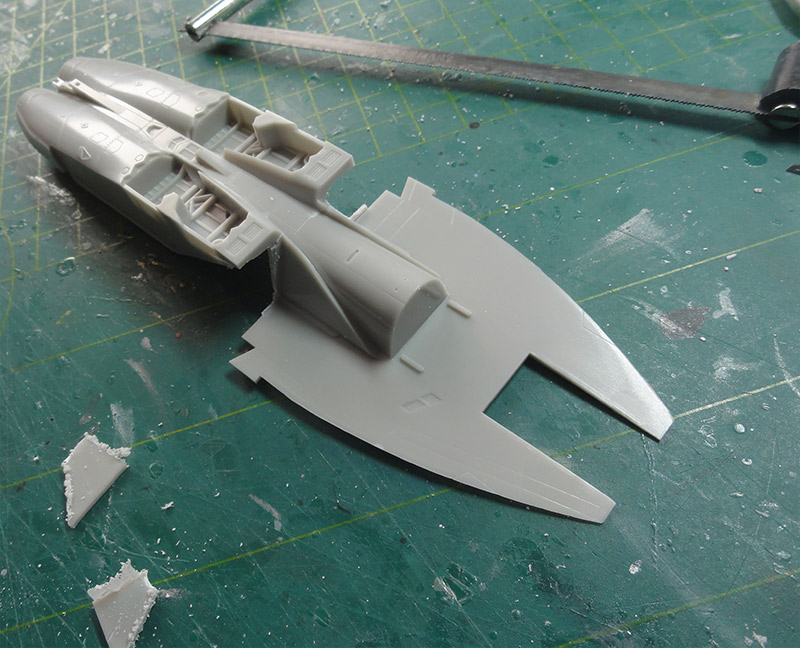
I was surprised that quite some putty and sanding was needed, at the lower areas at the intakes and the wing-fuselage joints. The rear fuselage also needed some putty and sanding. The rear slots were closed up.
On most Super Hornets between the vertical tails are 2 pairs with each 3 cooling vents and fairings, these were made from scrap (see photos below).

Some shrink marks were seen in the main wheels and filled.
On the top of the nose a rectangular panel is seen moulded by Hasegawa and this is correct for this F/A-18E version.
On the vertical tail tops are nicely moulded ECM fairings; (the ECM fairings typical seen on the first generation F/A-18C and F/A-18D are not present any more, probably now all integrated inside the jet).

Quite some putty is needed!
Sanding done.... Note the wing saw tooth extension and large LERX, typical op the next generation Super Hornet.


The early released kit misses some features that were later changed on the operational US Navy F/A-18, probably to fight fatique. The few slots moulded between the tail fins were gone so filled up and some re-enforcement structures were added. These were made from plastic card and set between the tail fins.

Here the large -E/F Super Hornet intakes are seen very well. The gear bays need another brushed white coat. Inside the gear bays are many hydraulics and some suggestion is done by raised moulded edges on the kit parts; for this scale adequate.


The smaller parts likes gears will be installed later, first the general paint scheme was to be airbrushed. A base grey coat was airbrushed to check for any flaws with the usual technique with Revell 75 steingrau Aqua acrylic. Thin Aqua with 40% distilled pure water and 10% IPA (*iso propyl alcohol).
No additional repairs were needed.

Paint scheme followed using Gunze Sangyo Mr.Hobby acrylic paints. The lower surfaces and stores and pylons were airbrushed FS36375 with Gunze Sangyo Mr.Hobby H308. Some masking was done and than followed the upper surfaces FS36320 with Gunze H307. There are also tiny trailing edges in FS35237 on upper and lower wing and tail fins. Thin the Gunze paint with their own acrylic thinner ("medium blue label" and 400 indicates 400 ML content).


These needed masking again and a coat of Gunze H337. For the VFA-14 scheme, the tail fins were airbrushed gloss black (and their trailing edges H337).
The model had now it basic colours. As operational US Navy Super Hornets often shown quite some weathering, some additional effort was done. Some patches were airbrushed on the upper surfaces with H308. And reverse, some lower patches airbrushed with H307. Some black was mixed in and and subtle airbrushed at some panels and flap edges.
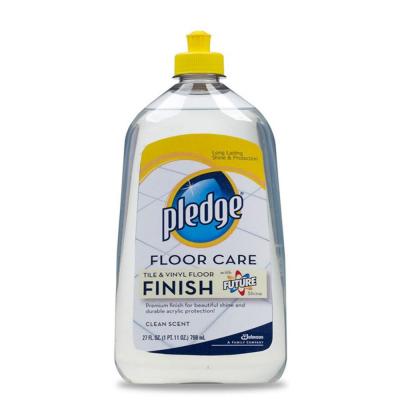

The model than got a few coats of gloss varnish with Johnson Future/ Pledge thinned with 5% Gunze Mr.Color leveling lacquer based thinner. To to protect the painted surfaces before some extra weathering effect was to be added, using the "water and salt" technique. mix was made of table salt and water. This was dripped on the surfaces. Let dry for an hour.
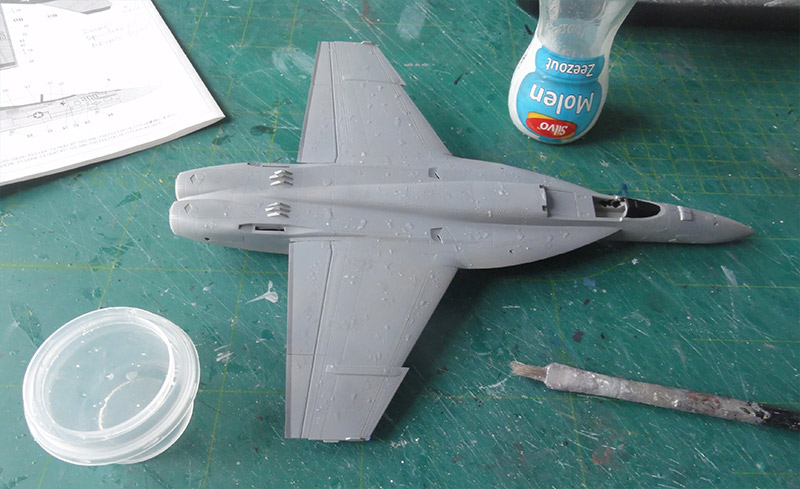
Than another few patches were airbrushed with H308 acrylic. The paints dries quickly. With a tooth brush the "salt drips" were removed and the model cleaned up. The results is that various subtle spots are seen that gives an "used effect".
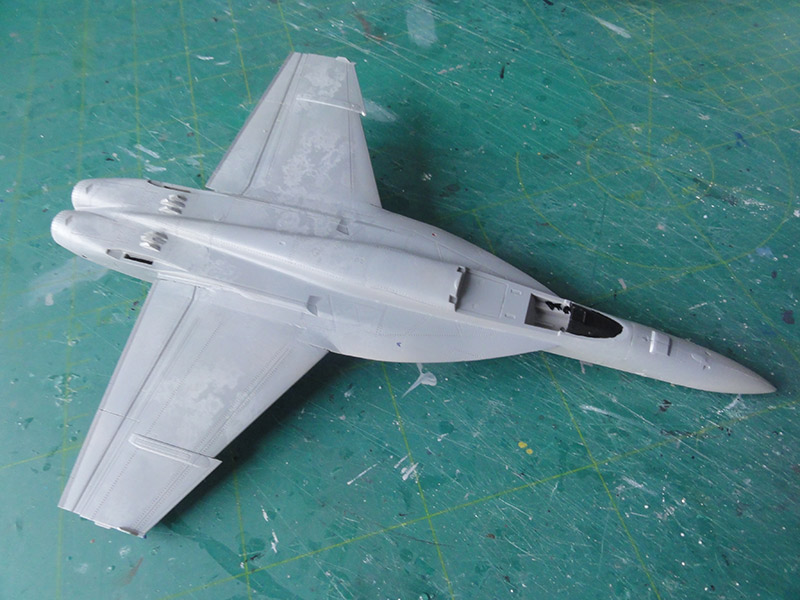
Note here the scrap made 2 pairs of 3 cooling vents between the vertical tails are seen.
The model was now decalled (surfaces were glossy) with the Hasegawa kit VFA-14 Tophatters decals. The tail fins were airbrushed black so got the separate decals. But the spine and tips of wing and stabilizers got the kit decals.

The Hasegawa kit decals are OK but take some time to get "off the wetted decal paper"...

At the black spine, some black paint was needed.
When decalled, the remainder of the parts were installed like gears and stores.
The main gear doors got retraction rods made from thin white plastic stretched sprue bits. In the front nose gear bay, a metal actuator was made from scrap and the gear doors also got retraction rods. The main colour here is white.
The anti-collision lights were brush painted. On the lower wing outboard aileron fairing on the outboard front edge were painted a red light at lower port and blue at lower starboard. On each vertical tail, an red anti-collision light was painted; it is moulded on the kit parts above the small "fuel vent intake". The stubs at the vertical trailing edges are ECM fairings, their ends were painted medium grey.
The model now got a few end coats of semi-mat varnish with Johnson Future/ Pledge thinned with 5% Gunze Mr.Color leveling thinner and 5% Tamiya matting X-21 agent added.
Final steps....
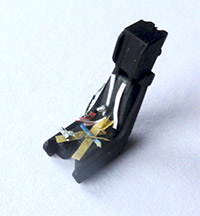
The seat was painted with black frames and olive green pads and got some harness straps from tape. A few red details were also painted. The kit canopy frames were hand painted and inside the front frame got 3 mirrors from scrap. All was set.


The result is a nice F/A-18E US NAVY model.
... set in a scenery...


Italeri of Italy came quite early in 1997 with a 1/72 kit #083 for a single seat F/A-18E SUPER HORNET.
In 2003 Italeri came with kit #093, SEEN ABOVE, for the F/A-18F two seater that had similar parts with a different canopy.
At the time the real F/A-18E -F Super Hornet was still in development. So the kit has some pre-production jet features like the air brake between the tail fins and extra vents above the intake ducts and the decals were for a pre-production jet. Wing pylons have an early style trailing edge.
The generic parts layout is seen here. The light grey plastic is rather soft but has simple engraved panel lines.

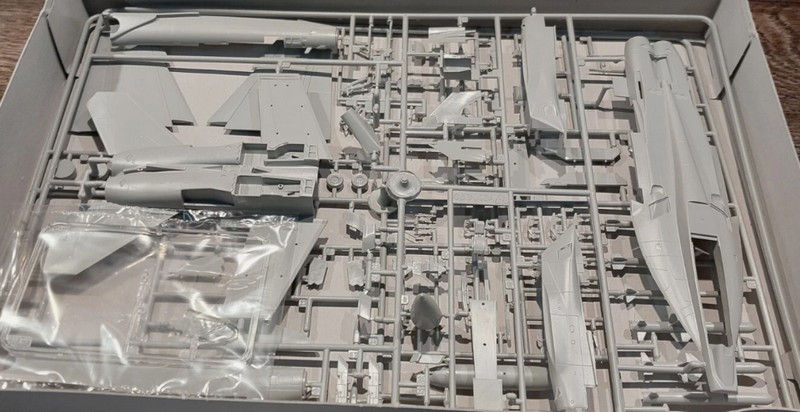
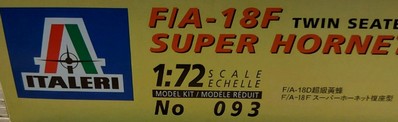
The transparant sprue C (not shown) has the canopy and wind screen parts.

The decals in this old Italeri kit are basic and for a low visibility pre-production jet used for US NAVY tests. The smaller stencilling is missing. Note that later produced operational F/A-18F were quite different so the decals sheet is rather simple.
Many years ago this kit I made as per instructions and set aside as the type was not yet in operational US Navy use. I think it was in 1998. Quite some putty and sanding was need at the lower LERX areas, intakes and rear fuselage. (I had not yet my own internet website! ). The made model sat at the "rear bottom shelf" waiting to be picked up and finished in a more attractive US Navy paint scheme. Note that the model had already gotten the landing gears, doors and other bits installed; normally I do that at a far later build stage.

Over 20 years later !! I got from my modelling friend Bas some colourful Hasegawa F/A-18F decals as found in their kit #00960. Thank you Bas!
The decals I got is are for a US NAVY VFA-102 "Diamondbacks" F/A-18F as on their 50th anniversary in 2005, based at Japan Atsugi air base in Prefekt Tokio. So it is probable Hasegawa from Shizuoka Japan could have visited the squadron in Japan to research the decals. The box top photo is spectacular.
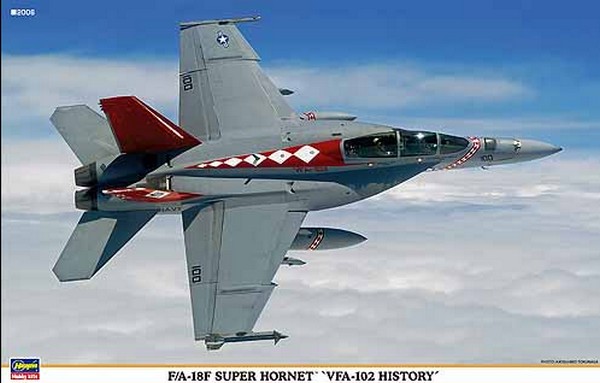
So I needed a standard operational F/A-18F model and decided to update the old made Italeri model. So needed modifications to the old made "pre-production" Italeri kit: the airbrake was set closed and a few slots were also closed, all is seen below...
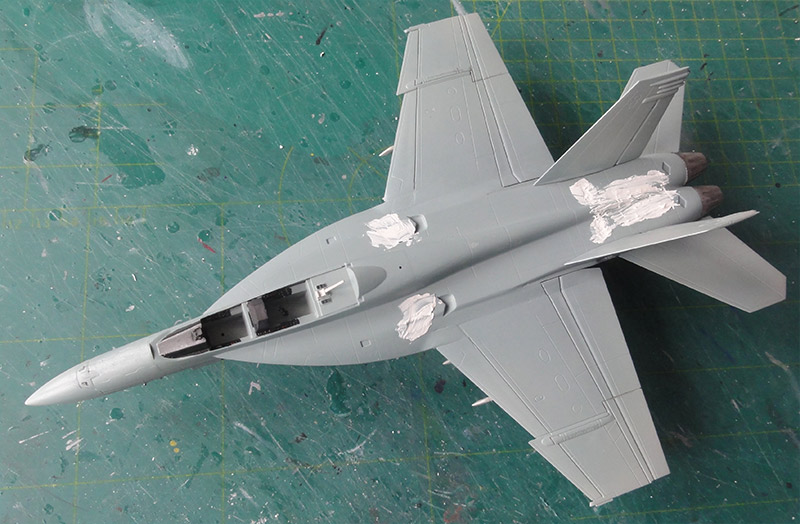
The vents above the ducts were earlier closed up but the main vents kept open. There may be more subtle changes like panels but I did not bother further. Sanding was done and than grey was airbrushed.

On operational Super Hornet 2 pairs of 3 cooling vents/ fairings are seen and these were made from plastic card and set in between.
 .
. (I forgot at this stage.... on the top of the nose a rectangular panel is seen on the F/A-18E and F/A-18F version. It was not moulded by Italeri as it was probably a later update. The panel will be made with a piece of thin bended plastic card).
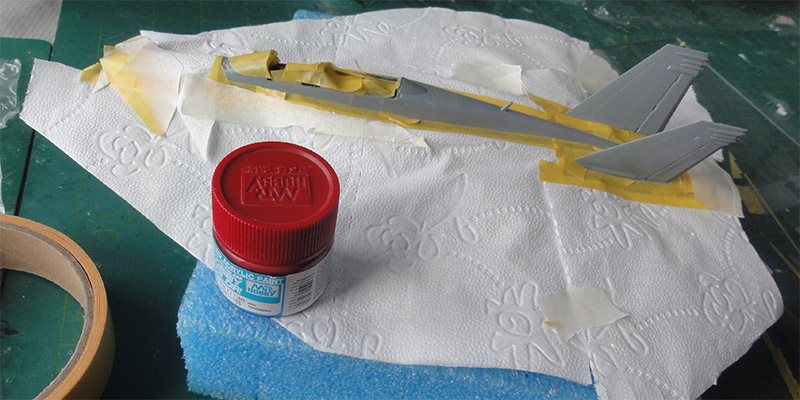
The Super Hornet model got a similar US Navy paint scheme as described above for the Hasegawa kit. The lower surfaces and stores and pylons were airbrushed FS36375 with Gunze Sangyo Mr.Hobby H308. Some masking was done and than followed the upper surfaces FS36320 with Gunze H307. There are also tiny trailing edges in FS35237 on upper and lower wing and tail fins... seen masked below...

I also did the weathering with darker and lighter paint patches and the "water with salt" technique (described above).
Some pre-weathering was done with mixes of grey and a few drops of Gunze black. (Note that I forgot
the rectangular panel on the nose is seen on the F/A-18E and F/A-18F version). Was added later.

For this model, the landing gears and pylons had already been set but usually I do that after decalling.
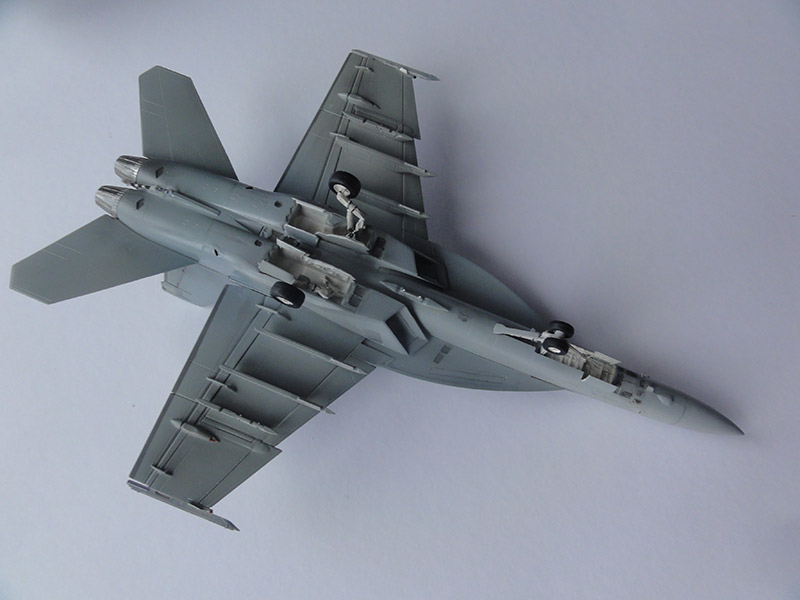
Ensure a glossy surface with a gloss varnish airbrushed coat to avoid "decals silvering".

The decals of the Hasegawa kit #00960 give you the option to paint after masking this red trim and add decals or use full kit decals that include the red. I decided to do a mix: tails and spine was airbrushed after masking and the wing tip and stabilizer tips were to be done with the decals.
This US NAVY VFA-102 scheme has a dark red trim for which Hasegawa in kit #00960 suggests Gunze Sangyo Mr.Hobby H327 acrylic paint.

So the spine and tails were masked and airbrushed acrylic Gunze Sangyo Mr.Hobby H327 FS36116 red.

The canopy frames were brush painted and the result is seen here...
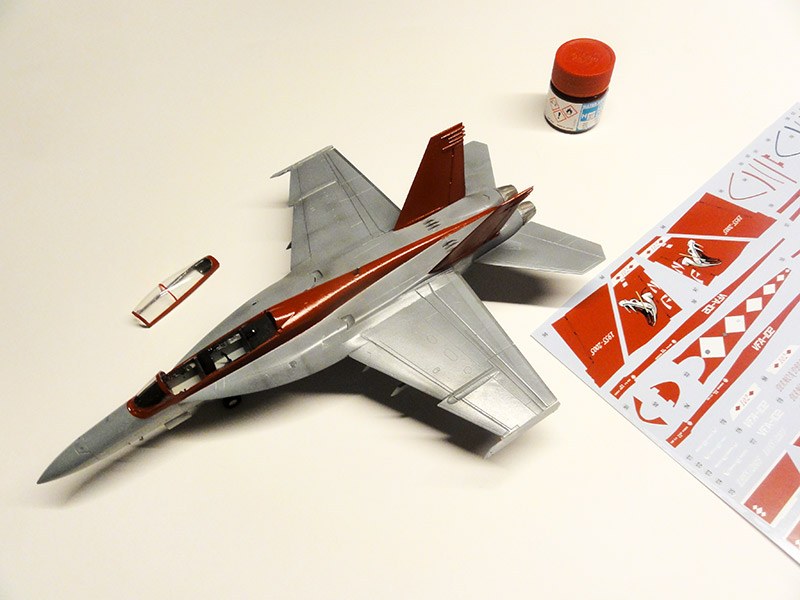
The model surfaces were glossy, so the decals were applied.
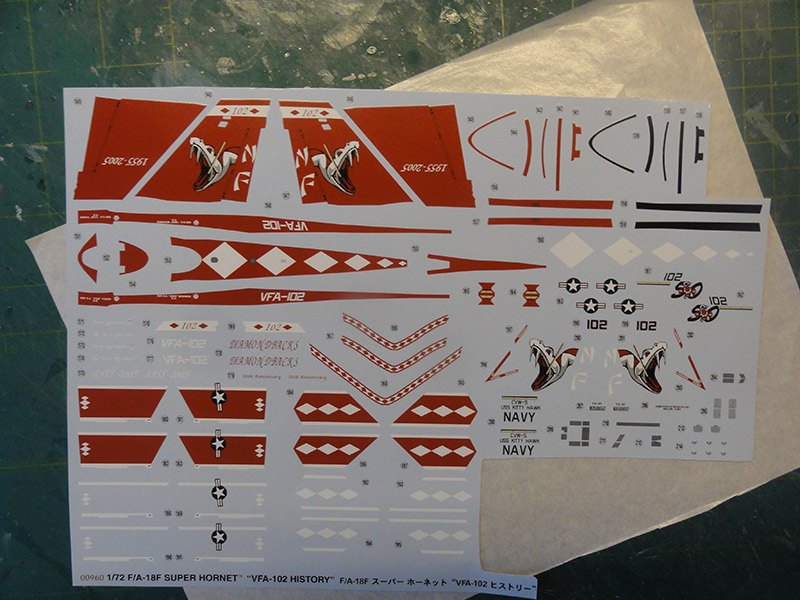

The Hasegawa decals have tock quite some time in water to get loose from the decals sheet and had a bit difficulty to conform to curved surfaces, some persuation was needed with a brush and clear varnish.
Hasegawa does not provide the many decals for NO STEP and I think these should be there. I got spare stencils NO STEP decals from a Ronin Decals RAAF set from Australia. Also, the black tri-angle panels of the forward cockpit sides should be there on both port and starboard. So made from spare black decals sheet.


A bit weathering wash got brush painted in gear bays and gear legs. Also inside any recessed flap and aileron edges.
The windscreen, canopy and other small bits were hand painted. Inside the canopy front frame 3 mirrors and on the lower frames locks were added from scrap.
It was decided to add AN/ASQ-228 designator pod on the centerline pylon with 2 GBU-12 laser guided bombs.
This pod is also often seen installed on the port intake fairing. (it seems also AN/AAQ-28 are used).
A pair of modern AIM-9X air-to-air missiles were set at the wing tip launchers. They came for various spares including Hasegawa weaponsets.

A final check was done.....
On the top of the nose a rectangular panel I had forgotten seen on the F/A-18E and F/A-18F version. It was not moulded by Italeri as it was probably a later jet update; this was made from thin bended thin plastic card, set and painted.
I also saw that the big antenna on the fuselage spine is more relocated to the rear. This details are clearly seen on the boxtop! These adaptions are easily done.
A final semi-gloss varnish was airbrushed. Shield off the transparancies obviously. That completed the model.


A whole series of 1/72 F/A-18 Hornets models for both my US Navy collection and the World Air Forces in Plastic collection. Still various kits are to be made...
Back to 1/72 Models


(c) Copyright Meindert "designer"/ All rights reserved. Your comments are welcomed by webmaster
Created this page May 2 , 2026